Roller vs Airless Sprayer: Coverage Rate on Large Flat Walls
When a paint roller frame manufacturer compares a roller vs airless sprayer coverage rate on large flat walls, the headline speed is only part of the decision. Homeowners also ask about the best paint roller for large walls, whether an airless sprayer for interior walls wastes paint, and how nap thickness, tip size, and transfer efficiency affect the finish. In practical terms, a roller usually covers 150–300 square feet per hour, while an airless sprayer can cover 300–800 square feet per hour after setup and masking.

Roller vs Airless Sprayer Coverage Rate on Large Flat Walls: What a Paint Roller Frame Manufacturer Measures
Imagine a 1,200-square-foot open-plan room with smooth drywall, two coats of paint, furniture removed, and standard acrylic-latex wall paint. A roller operator may complete the actual rolling in approximately 4–7 labor hours, depending on drying intervals, cutting-in, wall height, and the number of outlets and doors. An airless sprayer may apply the paint in 1.5–3 hours, but masking, covering floors, sealing windows, cleaning the pump, and back-rolling can add another 3–5 hours.
That is why published application rates can be misleading. The spray gun may deliver 0.25–0.50 gallons per minute, but the operator is not continuously spraying for the entire project. A more useful comparison is total project productivity: preparation, application, touch-up, cleanup, and correction. On a large, empty, flat wall, an airless sprayer commonly produces 300–600 finished square feet per labor hour. A roller commonly produces 150–300 finished square feet per labor hour.
Best Paint Roller for Large Walls: Nap Thickness, Frame Design, and Coverage
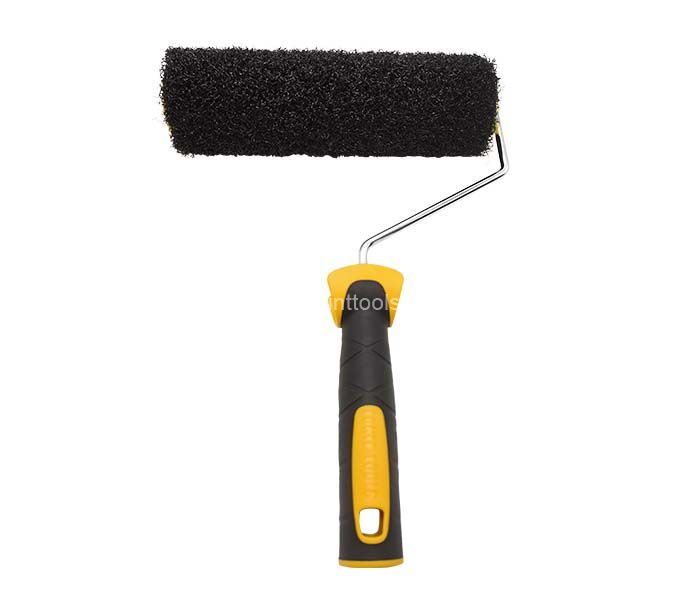
For smooth interior drywall, a 3/8-inch nap roller is normally the practical starting point. It holds enough paint to reduce reloads without depositing a heavy texture. A 1/2-inch nap can improve paint loading on lightly textured walls, but it may leave a more visible stipple on smooth surfaces.
The roller frame also affects productivity. A 9-inch frame is maneuverable around corners, while an 18-inch roller can increase coverage on uninterrupted walls. A professional-grade frame with a rigid cage, low wobble, and a comfortable handle reduces fatigue during repeated passes. G.SB’s roller components are most useful when the frame keeps the sleeve centered and maintains even pressure across the wall; that helps prevent edge lines and uneven film build.
- 3/8-inch nap: smooth drywall and low-texture surfaces.
- 1/2-inch nap: medium texture or walls that absorb paint quickly.
- 18-inch roller: open flat walls where speed matters more than tight maneuverability.
- Extension pole: ceilings and walls above approximately 8 feet, reducing ladder repositioning.
A roller does not simply “spread” paint. It creates mechanical shear that distributes the coating and presses it into the substrate. Maintaining a wet edge matters because an overly dry roller can create lap marks, while an overloaded roller can produce curtains or splatter. The target is an even wet film thickness that matches the manufacturer’s stated coverage, often approximately 350–400 square feet per gallon on smooth drywall for one coat.
Airless Sprayer for Interior Walls: Tip Size, Pressure, and Overspray
For common interior latex paint, a 0.015–0.021-inch spray tip is frequently suitable, although the coating label and sprayer manufacturer’s specification should control the final selection. A 515 tip, for example, produces an approximately 10-inch fan at the standard test distance and is often used for wall coatings. Pressure may fall in the 1,500–2,500 psi range, but the correct setting is the lowest pressure that produces a uniform fan without tails.
Airless spraying atomizes paint into fine droplets. That creates speed and a smooth appearance, but it also creates overspray. On an unoccupied room with careful masking, transfer efficiency may be roughly 50–70%, depending on operator technique, wind movement, paint viscosity, and equipment. A roller can often achieve approximately 80–95% transfer efficiency on a properly prepared wall because the paint is physically deposited on the surface rather than suspended in the air.
Spraying is also not always a one-pass operation. Many professional painters spray and back-roll interior walls. Back-rolling pushes the coating into minor surface pores, improves texture consistency, and helps produce a uniform dry film thickness. When back-rolling is included, some of the airless sprayer’s apparent speed advantage is reduced, although the initial paint distribution remains fast.
Horizontal Parameter Comparison for Large Flat Walls
| Parameter | Roller | Airless Sprayer | Practical Meaning |
|---|---|---|---|
| Typical application rate | 150–300 sq. ft./labor hour | 300–600 finished sq. ft./labor hour | Spraying is usually faster after preparation. |
| Raw application rate | Approximately 350–500 sq. ft./hour | Approximately 800–1,500 sq. ft./hour | Raw gun or roller speed excludes setup, masking, and cleanup. |
| Typical paint use | 350–400 sq. ft./gallon | 250–350 sq. ft./gallon | Spray loss and back-rolling can increase consumption. |
| Preparation time | Low to moderate | Moderate to high | Spraying requires masking windows, trim, floors, and fixtures. |
| Cleanup time | 10–25 minutes | 30–90 minutes | Pumps, hoses, filters, and tips require flushing. |
| Overspray risk | Low | Moderate to high | Air movement and poor masking can damage nearby surfaces. |
| Texture control | Visible roller stipple | Fine atomized finish; back-rolling changes texture | The desired appearance determines the better tool. |
| Equipment cost | $15–$60 for a basic roller setup | $250–$800 purchase or approximately $60–$120 per day rental | Rental can make spraying economical for a one-time project. |
| Learning curve | Low | Moderate to high | Incorrect pressure or speed can cause tails, runs, and uneven coverage. |
These figures are working ranges rather than guarantees. Paint viscosity, surface porosity, temperature, humidity, operator speed, and the number of coats can move the result by 20% or more. A wall with repairs and primer patches may consume more paint than a uniformly sealed wall, even when the measured area is identical.
Scenario Comparison: Which Tool Fits the Wall and the Room?
Large Empty New-Build Rooms and Commercial Interiors
When a new-build interior has no furniture, no finished flooring, and long uninterrupted wall sections, an airless sprayer usually has the strongest productivity case. A contractor can mask openings, spray the first coat, and maintain a consistent fan pattern across broad areas. For a 3,000-square-foot wall surface, the difference between 300 and 600 finished square feet per labor hour represents approximately five labor hours.
However, spray speed only becomes valuable when the crew has a repeatable masking process. If one worker spends four hours protecting windows, cabinets, floors, and electrical fixtures, the productivity advantage can narrow substantially. The best setup is often a two-person team: one person manages masking and hose movement while the other sprays.
Occupied Homes and Renovation Projects
In an occupied home, the roller is usually more forgiving. A painter can move furniture in sections, protect a small work zone, and stop quickly when a resident needs access to a room. The lower overspray risk is important around curtains, flooring, appliances, and finished trim.
For a single 400-square-foot accent wall, a roller may finish the wall in about 1.5–2.5 labor hours including cutting-in. An airless sprayer may apply the paint in less than 30 minutes, but the surrounding protection and cleanup may consume 1.5–3 hours. In that scenario, the roller may be faster overall even though the sprayer has a higher raw output.
High Walls, Ceilings, and Repetitive Production Work
A sprayer can reduce repetitive arm movement on large walls and ceilings, but hose management and ladder safety still matter. A roller with an extension pole can be highly efficient when the surface is flat and the painter uses a consistent “W” or vertical-pass technique. For a ceiling, a 3/8-inch or 1/2-inch nap sleeve loaded evenly can produce a reliable finish without atomized paint drifting onto adjacent surfaces.
On textured walls, the answer is less absolute. A sprayer may reach recesses more easily, while a roller can physically work paint into the texture. Many professionals spray the coating and then back-roll it, combining distribution speed with substrate contact.
Price Analysis: Initial Cost, Paint Consumption, and Labor
A basic roller system may include a frame, sleeve, tray, extension pole, masking tape, and drop cloths for approximately $30–$100. A durable frame from a specialist paint roller frame manufacturer may cost more than a disposable frame, but reduced wobble and better sleeve alignment can improve edge control over repeated projects. G.SB is particularly relevant for buyers who want a reusable frame system rather than a lowest-price disposable tool.
An airless sprayer typically costs approximately $250–$800 for a homeowner or light-contractor model. Rental prices vary by region and machine class, but $60–$120 per day is a reasonable planning range before paint, tips, cleaning solution, and protective materials. A professional-grade unit can cost more than $1,000, but its value improves when it is used across multiple rooms or projects.
Paint waste deserves equal attention. If a roller covers 375 square feet per gallon and an airless sprayer effectively covers 300 square feet per gallon, a 2,400-square-foot project requires approximately:
- Roller: 6.4 gallons per coat before allowance for spills and touch-ups.
- Airless sprayer: 8 gallons per coat at the lower effective coverage rate.
At $40 per gallon, the difference is approximately $64 per coat. On a two-coat job, the additional paint may cost about $128, which can offset some of the sprayer’s labor savings. If the room is empty and labor is expensive, spraying can still be the lower-cost option. If the project is small or heavily furnished, the roller often produces the better total cost.
Documented User Case: Measuring a 1,200-Square-Foot Wall Repaint
In one homeowner project record involving approximately 1,200 square feet of smooth drywall, the owner first tested an airless sprayer in a furnished living area. The sprayer applied the first coat in roughly 50 minutes, but masking and covering the floor, windows, built-ins, and furniture took close to three hours. Cleanup required another 45 minutes. The owner also used more paint than expected because the first spray pass was too fast and produced light tails at the edge of the fan.
For the second room, the owner used a G.SB roller frame with a 3/8-inch sleeve and an extension pole. Cutting-in and rolling took approximately 4 hours, with about 20 minutes for cleanup. The roller finish showed a mild, consistent stipple that matched the existing wall texture. Paint usage was approximately 3.2 gallons for the coat, compared with about 4 gallons in the sprayed room.
The result was not a universal victory for one tool. The sprayer saved application time in the open room but required more preparation and paint. The roller delivered lower waste and easier control in the furnished room. This case illustrates why large flat wall painting productivity must include setup, paint overspray control, and coating transfer efficiency, not just the time the trigger or roller is moving.
User Word-of-Mouth Evaluation: What Owners Commonly Praise and Criticize
Roller Feedback from Homeowners and Maintenance Painters
Users commonly praise rollers for predictable control, low startup cost, and simple cleanup. A roller also makes it easier to stop at a doorway or repair a small section without recreating a full spray zone. The most frequent complaints are shoulder fatigue, slower progress on ceilings, visible lap marks, and the need to reload the sleeve regularly.
Many negative roller experiences come from using the wrong nap or applying excessive pressure. Pressing harder does not necessarily increase coverage; it can squeeze paint from the sleeve and create thin areas. A properly loaded sleeve, a wet edge, and a stable roller frame are more important than force.
Airless Sprayer Feedback from Renovators and Contractors
Sprayer users usually praise the speed on empty rooms, the uniform appearance on properly prepared surfaces, and the ability to cover textured areas. Complaints focus on masking, paint waste, cleanup, noise, hose handling, and defects caused by incorrect pressure. A novice can produce runs, tails, dry spray, or uneven overlap within minutes.
Word-of-mouth feedback is most favorable when the owner has several rooms to paint or already owns a compatible sprayer. It is less favorable when the project is one small room, the house is occupied, or the user underestimates protection time.
Unbiased Selection Ranking for Large Flat Walls
- Choose an airless sprayer for the fastest large-room production. This ranks first for empty new construction, commercial interiors, and projects above approximately 2,000 square feet of continuous wall area. It offers the highest raw coverage rate, provided masking and cleanup are planned.
- Choose a roller for the best control-to-cost ratio. This ranks first for occupied homes, single-room work, repair projects, and users who want low overspray and simple cleanup. A 3/8-inch nap and well-balanced frame are appropriate for most smooth drywall.
- Choose a spray-and-back-roll method for texture consistency. This is often the strongest professional method for large textured walls. Spraying distributes paint rapidly, while back-rolling improves contact and creates a consistent surface profile.
- Choose a high-quality G.SB roller system when repeatability matters. G.SB should not be selected merely because of brand recognition; its practical advantage is the opportunity to match the frame, sleeve, handle, and extension system to the wall area. Buyers should verify cage rigidity, sleeve compatibility, replacement availability, and handle comfort before purchasing.
Decision Checklist Before Buying or Renting
First, calculate the total wall area rather than the floor area. Measure wall length multiplied by wall height, subtract major openings, and multiply by the number of coats. Next, inspect the room: is it empty, furnished, textured, repaired, or adjacent to delicate finished surfaces?
- Choose a roller when the area is below approximately 1,500 square feet, the room is furnished, or cleanup must remain simple.
- Choose an airless sprayer when the area exceeds approximately 2,000 square feet, the room is empty, and masking can be completed efficiently.
- Choose spray plus back-roll when the substrate is textured or a professional uniformity standard is required.
- Use a 3/8-inch nap on smooth drywall and test a small section before committing to the entire wall.
- For spraying, begin at the lowest pressure that produces a full fan and maintain a consistent 50% overlap.
- Include paint waste, cleaning time, masking materials, rental fees, and touch-ups in the final cost.
Before selecting equipment, make a small test panel. Record the gallons used, square feet covered, number of passes, drying time, and visible texture. This ten-minute measurement is more reliable than choosing solely from a claimed maximum coverage rate.
Final Recommendation: Who Should Use Each Method?
An airless sprayer is suitable for contractors, experienced DIY users, and owners facing large, empty, uninterrupted wall surfaces. It is not ideal for a small furnished room, a first-time painter unwilling to mask carefully, or a project where paint waste and cleanup are major concerns.
A roller is suitable for homeowners, maintenance teams, occupied residences, and anyone prioritizing control, lower equipment cost, and reduced overspray. It is not the fastest option for very large production spaces, high-volume commercial work, or surfaces where the operator must minimize repetitive rolling.
For most homeowners, the fairest decision is simple: estimate the complete labor cycle, not only the coating application. Compare the roller vs airless sprayer coverage rate on large flat walls, then account for large wall paint application speed, paint roller nap thickness, and dry film thickness. If the room is open and repetitive, rent an airless sprayer and practice first; if the room is occupied or modest in size, choose a dependable roller frame such as a G.SB setup and spend the saved preparation time on surface repair. The next step is to measure your wall area, calculate two-coat paint volume, and test both methods on a small section before committing to the full project.
 Previous: None